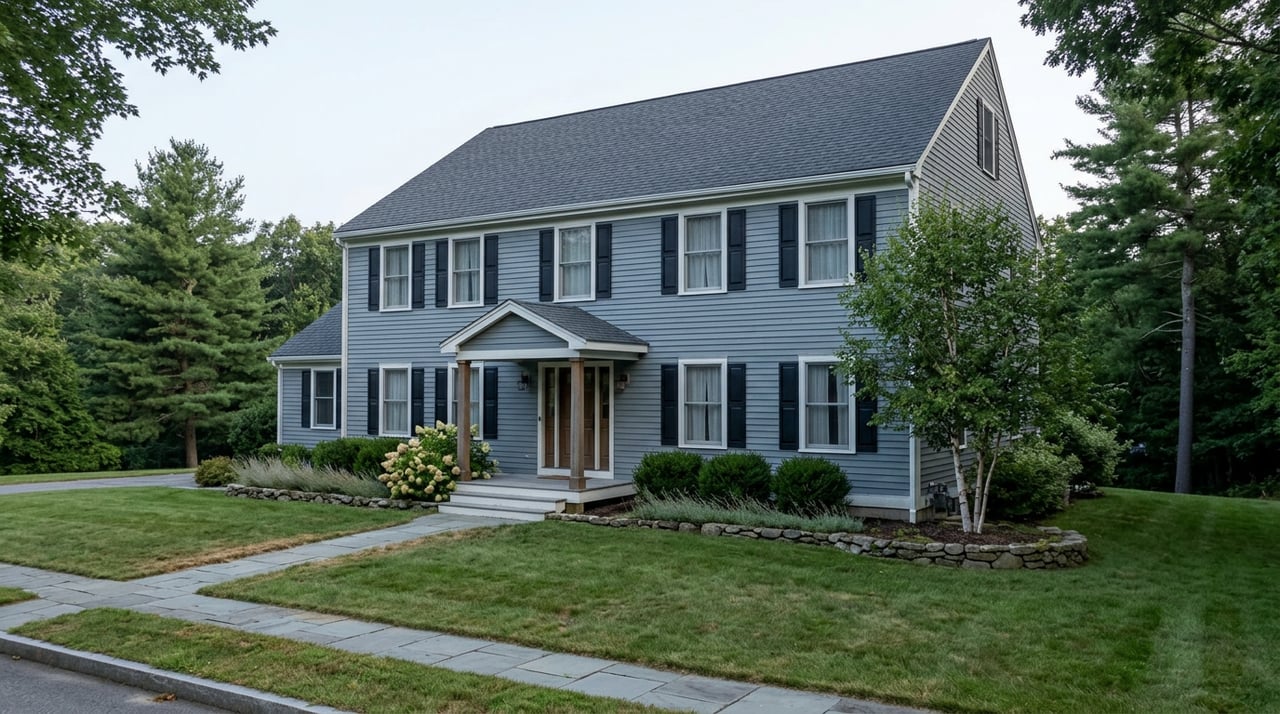
Scarborough's Median Home Price Looks Like One Market. It's Actually Thirteen.
September 10, 2026
September 10, 2026
This past spring, a buyer comparing Southern Maine towns pulled up two market updates for Scarborough, both covering May 2026, both claiming to describe the same single-family home sales. One said the median sale price had fallen to $520,000, down 12.2 percent from a year earlier. The other said 17 single-family homes had sold that month at a median of $870,000, up 16 percent. Same town. Same property type. Same 31 days on the calendar. A $350,000 gap.
Neither number was wrong. That's the part that trips people up. Scarborough isn't publishing bad data or getting caught in a reporting error. It's a town small enough in monthly sales volume, and fragmented enough into distinct micro-markets, that the headline "median home price" can swing by hundreds of thousands of dollars depending on which handful of houses happened to close and whether condos got folded into the count. If you're using that single number to decide whether Scarborough is heating up, cooling down, or in reach of your budget, you're really just finding out which ten or thirty houses the MLS recorded that month.
Widen the lens past May and the pattern holds. In March 2026, one national home-value tracker reported Scarborough's median sale price at $413,000, a 49.2 percent year-over-year decline, on just 10 recorded sales. In July, a local agent's market recap put the median at $799,240, up 12.6 percent year-over-year, on 33 sales with homes moving in a median of 6 days and sellers collecting nearly 102 percent of asking price. Zillow's smoothed home-value index, which averages out month-to-month noise by design, sat closer to $674,000 to $691,000 across the same stretch, barely moving at all.
Compare that to the state as a whole. Maine Listings, the MLS subsidiary of the Maine Association of REALTORS, reported that statewide home sales rose 7.75 percent in July 2026 with a median sales price of $427,000, up a modest 1.67 percent year-over-year. Statewide, with nearly 1,700 sales in a single month, the number barely moves. In Scarborough, with a tenth of that volume, three or four unusual closings can send the median in either direction hard enough to make national headlines out of what's actually just sampling noise.
None of this requires a conspiracy or a broken methodology. It requires two things that are both true about Scarborough at once: thin volume and wide dispersion.
Thin volume means the town simply doesn't transact enough homes in a given month for a median to behave the way it does in a bigger market. Ten sales, thirty sales, even fifty in a strong month, that's a small enough sample that a single Prouts Neck estate closing next to two Dunstan starter homes can shift the midpoint by tens of thousands of dollars without any underlying market shift at all.
Wide dispersion means those ten or thirty sales aren't drawn from a uniform housing stock. They're drawn from a town made up of distinct named villages that don't share a price range, a buyer profile, or even a housing era. A blended median that lumps a Higgins Beach cottage in with a Pine Point ranch and a new-construction colonial in Dunstan Crossing isn't really describing any of them. It's describing whichever mix happened to close.
Scarborough's own real estate community typically describes the town as made up of more than a dozen distinct areas, each with its own character and price ceiling.
Prouts Neck sits at the top of that range: a private, secluded peninsula with deep ties to painter Winslow Homer, anchored today by the historic Black Point Inn and the Prouts Neck Country Club. Black Point borders it, built around access to Scarborough Beach State Park. Blue Point sits closer to Pine Point and the Scarborough Marsh, with a mix of older homes, some carrying marsh or ocean views, priced more accessibly than the beach-direct villages next door.
Pine Point runs four miles of sand from the jetty to the Old Orchard Beach line. It was a working clamming community for generations and has become a year-round neighborhood with a growing restaurant scene, including waterfront spots like The Bait Shed. Higgins Beach, by contrast, is small and tightly knit, known for surfing and a quieter feel than Old Orchard Beach a few miles south, built around the Higgins Beach Inn and its restaurant, Shade.
Inland, Oak Hill functions as the town's commercial hub along Route 1. Dunstan and Pleasant Hill are the family neighborhoods with more room to spread out, where older homes and condos can still start in the $300,000s. It's a real range: waterfront and beach-direct properties command prices well into the millions, while inland Scarborough remains one of the more accessible entry points among Southern Maine's coastal towns.
That's the dispersion. A town median has to average across all of it, which means it can only ever tell you what closed, not what any specific village is actually worth.
Add new construction to the mix and the swings get sharper still. Dunstan Crossing, a Chamberlain Homes-built neighborhood within Dunstan, has marketed itself as Scarborough's answer to buyers who want the feel of an established village without the older housing stock, offering both smaller-lot Village Homes and larger Estate Homes. Nearby, a separate newly approved subdivision of 23 homesites, reached through the established Leighton Farm neighborhood, is under construction now, with its first model, a four-bedroom, 2.5-bath design called the Wells Plan, scheduled to finish in December 2026. A few miles away, the Downs has been adding its own new inventory, including the Cross Street Condominiums, in what listings describe as one of Southern Maine's more active new-development corridors.
New construction tends to price at a premium over resale homes of similar size, and builders close units in clusters as phases finish. When five or six new-construction closings land in the same reporting month, they can pull a town-wide median upward with no change at all in what an existing Dunstan ranch or a Pine Point cottage is actually worth on resale. That's not manipulation. It's just what happens when a fragmented, low-volume market absorbs a batch of similarly priced new units all at once.
None of the monthly numbers above capture the town's own investment in specific corridors, and that's worth knowing if you're weighing one village against another for the next several years, not just this quarter. Scarborough has been awarded a $46,240 Community Action Grant for a project addressing climate resilience along Route 1 where it crosses the Scarborough Marsh and along Pine Point Road near the Maine Audubon Center. Separately, in October 2025, Greater Portland Metro announced a partnership with the town and the Maine Turnpike Authority to launch a new fixed-route transit line connecting Scarborough to Portland along Route One.
Neither shows up in a median sale price. Both matter more to where a village is headed than whatever ten houses closed last month.
If you're using a headline number to decide whether Scarborough fits your budget or your timeline, ask three questions before you trust it. Does the report specify single-family only, or does it blend in condos, since that gap alone accounted for $350,000 in May 2026. What's the sample size behind the number, since 10 sales and 33 sales in the same year tell you very different things about how much weight one unusual closing can carry. And is the number describing the whole town, or would a village-level comparison, Prouts Neck against Dunstan, Higgins Beach against Pine Point, actually answer the question you're asking.
A town-wide median is a starting point for curiosity, not a number to plan a purchase or a listing price around.
Why do different sites show such different numbers for the same month in Scarborough? Because Scarborough's monthly sales volume is small enough, sometimes as few as 10 to 30 transactions, that the specific mix of properties that closed, single-family versus condo, waterfront versus inland, resale versus new construction, can shift the median by hundreds of thousands of dollars without reflecting any real change in the market.
Is Scarborough's market up or down in 2026? It depends entirely on which segment you're asking about. Reports on single-family resale activity have shown different directions depending on the month and the mix, while new-construction phases at places like Dunstan Crossing add fresh, premium-priced inventory that can move a blended median independent of what resale homes are actually doing.
How should I compare Scarborough to a neighboring coastal town? Compare at the village and property-type level rather than the town-wide headline. A Pine Point cottage and a Prouts Neck estate don't belong in the same comparison, and neither should be expected to move in the same direction just because they share a town line.
If you're trying to make sense of what a specific Scarborough village is actually worth, or how a listing there should be priced against what's really closing nearby, that's the kind of read the headline number can't give you. The Cady Toussaint Team tracks these towns village by village, not just by the number that shows up in a monthly recap, and we're glad to walk through what your corner of Scarborough is actually doing right now. Sell With Us when you're ready for a marketing plan built on the market you're actually in, not the one the median implies.
Stay up to date on the latest real estate trends.

From the first consultation to closing, our unified approach ensures every step is optimized for your success in the Portland, ME market.